


Curriculum Intent
At Chessington School, our curriculum is designed to ensure that every child, every day, fulfils their potential. We believe that all of our students, regardless of background, starting point or need, are entitled to a rich, ambitious and inclusive education that equips them with the knowledge, skills and cultural understanding required to thrive from their first day with us, through to their future careers.
Our curriculum has been carefully constructed to provide our students with the critical knowledge, disciplinary understanding and personal development needed to become successful learners, responsible citizens and confident individuals. We are committed to ensuring that every student experiences success through a curriculum that is coherent, challenging and responsive to the needs of our learners.
We believe our students should experience a broad and balanced education for as long as possible, and we are exceptionally proud of our subject offer at all key stages. At both Key Stage 3 and 4, our students access a wide range of academic, creative, practical and performing subjects to secure a broad foundation of knowledge and discover their strengths and interests.
At Chessington School, the National Curriculum provides an important foundation for curriculum planning; however, we do not see it as the limit of our ambition for our students. By extending beyond statutory requirements, we ensure that all of our students, particularly disadvantaged learners and those who may face barriers to opportunity, can access a curriculum that broadens their horizons, raises their aspirations and enables them to have sustained success.
A knowledge-rich curriculum
The Chessington School curriculum sets out the essential knowledge, understanding and skills that our students need to learn at each stage of their education. We believe that secure knowledge is the foundation of future learning and that our students are empowered when they know more, remember more and can apply their learning confidently across contexts.
Our curriculum is carefully designed by our subject specialists within the school and across our Multi Academy Trust to ensure our curriculum offer is exceptional. Across all subject areas, curriculum plans clearly identify the key knowledge and disciplinary concepts that our students must master. Subject leaders have carefully considered what our students need to know, when they need to know it, and how learning is revisited to ensure long-term retention.
A well-sequenced curriculum that builds learning over time
Our curriculum is intentionally and carefully sequenced to build knowledge cumulatively over time. Learning is planned so that our students revisit and strengthen prior understanding while developing knowledge and skills.
At every key stage, our students encounter curriculum content in a logical progression, enabling them to make connections between ideas, deepen understanding and achieve mastery. Retrieval, repetition and deliberate practice support our students in remembering more and applying learning successfully.
Curriculum sequencing ensures that our students are well-prepared for the next stage of education, employment and adult life. We place significant emphasis on developing strong foundations in Key Stage 3 to ensure all of our learners are fully prepared for future academic pathways.
Ambition for every learner, every day
At Chessington School, we are unwavering in our ambition for all of our students. We reject the notion that background, disadvantage or additional need should limit achievement. Our curriculum is therefore designed to be ambitious and aspirational for every one of our learners, including students with Special Educational Needs and Disabilities (SEND), disadvantaged pupils and those with lower prior attainment.
Teachers adapt teaching thoughtfully so that all of our learners can access ambitious content while maintaining high expectations. SEND provision is integrated into curriculum planning, ensuring our students receive the support, scaffolding and challenge required to succeed.
High expectations are central to our curriculum design. We provide appropriate scaffolds, adaptations and targeted support without reducing academic challenge or entitlement. Our students access a shared curriculum because we believe inclusion means ensuring every learner has access to high-quality knowledge and meaningful success.
Curriculum through the lens of disadvantage
Chessington School serves a community with a significant proportion of disadvantaged students. This context is central to our curriculum thinking and informs our commitment to equity and inclusion.
We recognise that disadvantage can create barriers to academic success, cultural opportunity and educational confidence. As a result, our curriculum is intentionally designed to reduce these barriers and provide our students with the knowledge, experiences and cultural capital needed to succeed.
We ensure that all of our students have access to a broad, enriching curriculum that develops vocabulary, reading, cultural understanding and wider experiences. Curriculum leaders carefully consider what knowledge disadvantaged students may be less likely to encounter beyond school and explicitly teach this through planned curriculum, pastoral and enrichment opportunities.
Our curriculum commitment
At Chessington School, our curriculum is underpinned by a simple but powerful belief: every child, every day should have the opportunity to succeed. Through a carefully sequenced, knowledge-rich and highly inclusive curriculum, we ensure our students develop the knowledge, skills, character and aspirations needed to succeed academically and personally, now and in the future.
SEE OUR CURRICULUM ROADMAP BOOKLET HERE
Art
Head of Subject: Ms Hudspith
Contact: jhudspith@chessington.kingston.sch.uk
Overview
We aim to develop students’ visual literacy by reading, interpreting and analysing images and context. We develop critical thinking skills by understanding and challenging existing concepts and movements in art.
We give opportunities for skill development within a spiral curriculum, to build a ‘traditional’ art toolkit that gives students the skills they need to represent the world, express their ideas, and find their own creative voice.
Students have opportunities to explore different forms of drawing, painting, ceramics, print-making and more. We then test and challenge these methods to develop inventiveness, creativity, risk-taking and originality in our outcomes.
Creating links to the real world, we give students career insights and foundational skills they will need to be artists, designers and creative problem solvers of the future.
Key Stage 3
|
Year 7 |
Year 8 |
Year 9 |
|
|
Autumn 1 |
OBSERVING OBJECTS – How to draw with different media using the formal elements – line, shape, colour, tone, space, form, texture and mood. Artists – Bridget Riley, Van Gogh |
OCEAN LIFE – Using a wide range of media, understanding how artists are activists Artists – Amber M Moran and Yellena James |
IMAGINED REALITY – 1&2 point perspective. The impact of symbolism and juxtaposition. Careers in art. Artists – Méret Oppenheim, Rene Magritte and Salvador Dalí |
|
Autumn 2 |
|||
|
Spring 1 |
HUES OF FOODS – Embedding the formal elements with a closer look at colour theory. Artists – Wayne Thiebaud, Sarah Graham, Georgina Luck |
NATURAL PATTERNS – 3D clay modelling of the ancient coil pot technique. Block printing Artists – Kelly Jean Ohl, Zhu Ohmu |
IDENTITY – Facial proportions and features. Symbolism. Layered thinking for building a multimedia artwork Artists – Louie Jover, Kehinde Wiley |
|
Spring 2 |
|||
|
Summer 1 |
ANCIENT JAPAN – Focusing on tonal values, using mono printing and tonal inking techniques Artists – Tenshō Shūbun, Katsushika Hokusai |
BUGGING OUT – Developing our use of colour and 3D thinking through layers and recycled materials Artists – Christopher Marley, Michelle Stitzlein, Sibylla Merian and E A Seguy |
MAKE IT POP – Application of formal elements and deciphering images for stylisation. Typography. Artists – Michael Craig Martin, Yayoi Kusama, Roy Lichtenstein and Peter Blake |
| Summer 1 |
Key Stage 4
Exam board: AQA
Pathway/option: GCSE Art and Design (Art, craft and design) / Fine Art - 8201
Link to exam board: here
|
Autumn Term 1 |
Autumn Term 2 |
Spring Term 1 |
Spring Term 2 |
Summer Term 1 |
Summer Term 2 |
|
|
Year 10 |
NATURAL FORMS Macrophotography Tonal drawing Mono-printing Ernst Haeckel
|
NATURAL FORMS Natural History Museum trip Water colour techniques and bird studies
|
NATURAL FORMS Georgia O’Keefe Acrylic painting Clay artist for ocean study Clay sculpture |
NATURAL FORMS Final piece creation |
CITY LIFE Tonal drawings Trip and reportage practice
|
CITY LIFE London mixed media recording City photography Tate Modern reflections and recordings Artist study 1
|
|
Year 11 |
CITY LIFE Ian Murphy artist study Acrylic cityscapes with nontraditional application Soft pastels - brights Ink and wash |
CITY LIFE Final piece prep Final piece creation (mock exam) |
ESA Tonal drawings Artist study 1 Colour studies-oil/soft pastels Colour studies-watercolour/acrylic Artist study 2 |
ESA Final piece/ exam prep - -Ideas -Compositions -Media experiments -Artist study -Refinements |
ESA Final exam prep 10 hr exam |
Enterprise and Marketing
Head of Subject: Mr Cosgrave
Contact: bcosgrave@chessington.kingston.sch.uk
Overview
Enterprise and Marketing is offered as a GCSE Vocational option at Chessington School, following the OCR Cambridge Nationals Enterprise and Marketing specification. It provides students with a practical, real-world understanding of how businesses are set up, compete, and meet customer needs through effective marketing. It is important as it develops commercial awareness, creativity and financial literacy — skills that benefit students as future employees, consumers and potential entrepreneurs, while remaining transferable well beyond the subject itself. By the end of the course, we aim for students to confidently apply enterprise and marketing concepts to real business contexts, equipped with a qualification that supports progression into further study, apprenticeships and careers across a wide range of industries.
Key Stage 4
Exam board: OCR Cambridge Nationals
Pathway/option: Cambridge National in Enterprise and Marketing J837
Link to exam board: here
|
Autumn Term 1 |
Autumn Term 2 |
Spring Term 1 |
Spring Term 2 |
Summer Term 1 |
Summer Term 2 |
|
|
Year 10 |
Task 1 - Complete market research. |
Task 1 &2 - Identify a Customer Profile. |
Task 3&4 - Produce a design proposal/Develop a product proposal. |
Task 5&6 - Review the business proposal and factors that may impact success. |
Introduction to Component 2 Task 1 - Developing a brand. |
Task 2 - Create a promotional campaign. |
|
Year 11 |
Task 3&4 - Develop and deliver a Dragons Den pitch |
Task 5 - Reflection/Review of your pitch. |
Topic areas 1,2 & 3 - Risk, Reward, Research. Making a product viable. |
Topic areas 4 & 5 -Creating a marketing mix. Starting a new business. |
Revision and exam |
Catering
Head of Subject: Mrs B Ford
Contact: bford@chessington.kingston.sch.uk
Overview
The intent of the Catering and Hospitality curriculum is to deliver a robust, practical, and academically grounded education that transforms students from novice cooks into confident, industry-aware culinary practitioners.
We intend to equip students with a deep understanding of food science, advanced technical skills, and a comprehensive overview of the hospitality industry. This curriculum bridges the gap between domestic cooking and professional catering, focusing heavily on precision, food safety, time management, and the commercial realities of working in food service.
Key Stage 3
At Key Stage 3 Technology lessons rotate between 3 subjects; Catering, Textiles and DT each half term.
In catering, students complete one practical each week from the recipe books linked in the curriculum grid below.
|
Rotation 1 |
Rotation 2 |
|
|
Year 7 |
||
|
Year 8 |
||
|
Year 9 |
Key Stage 4
Exam board: WJEC
Pathway/option: Level ½ Hospitality and Catering vocational
Link to exam board: here
|
Autumn Term 1 |
Autumn Term 2 |
Spring Term 1 |
Spring Term 2 |
Summer Term 1 |
Summer Term 2 |
|
|
Year 10
|
Residential and non residential Commercial and non commercial Types of service Job roles and types of contracts
|
Qualifications, pay & benefits The Environment- the four R’s, sustainability Cost & profit in the business Technology and expectations in the business Use of social Media standards & ratings in the business Political issues affecting the industry |
Front of house layouts kitchen layout stock control record keeping fire safety first aid |
Health & Safety laws EHO Food poisoning Allergies Special diets |
HACCP COSHH RIDDOR HASAWA |
Revision Age groups Nutrients Cooking methods |
|
Year 11 |
NEA units chosen dishes Nutrients Age groups Cooking methods |
NEA units Factors affecting choice A successful business Timeplans |
NEA units Cooking Evaluations |
Revision Be ready for the exam |
Child Development
Head of Subject: Miss Rutledge
Contact: krutledge@chessington.kingston.sch.uk
Overview
The Early Years curriculum at Chessington school teaches the practical skills and academic theory needed to work in the childcare sector. Our vocational offer bridges the gap between classroom learning and professional placement. Students will develop a deep understanding of holistic child development, play-based learning, safeguarding, and inclusive practices. They will learn exactly how children grow and learn from birth to five years old. By studying areas such as nutrition, cognitive development, and health and safety legislation this qualification provides a direct pathway to T level courses, childcare apprenticeships, or employment in early years .
Key Stage 4
Exam board: NCFE
Pathway/option:
Level 1/2 Technical Award in Child Development and Care in the early years
Link to exam board: https://www.ncfe.org.uk/qualification-search/qualification-detail/ncfe-cache-level-12-technical-award-in-child-development-and-care-in-the-early-y-1613
|
Autumn Term 1 |
Autumn Term 2 |
Spring Term 1 |
Spring Term 2 |
Summer Term 1 |
Summer Term 2 |
|
|
Year 10 |
CA1: Child development |
CA2 : Factors that influence child development |
CA3: Care routines and play activities to support the child |
CA4: Early years provision |
CA5: Legislation, policies and procedures in the early years |
CA6: Expectations of the early years practitioner |
|
Year 11 |
CA7: Roles and responsibilities within early years settings |
NEA |
NEA |
CA8: The importance of observations in early years childcare CA9: planning in early years childcare |
Revision |
Finish |
NEA - Non-examined assessment (15 hours coursework piece, externally set internally marked and moderated)
Key Stage 5
Exam board: NCFE
Pathway: Level 3
Link to exam board/ specification : T level specification
|
Autumn Term 1 |
Autumn Term 2 |
Spring Term 1 |
Spring Term 2 |
Summer Term 1 |
Summer Term 2 |
|
|
Year 12 |
Elements 2 and 3 Elements 1 and 7 ongoing in Piglets |
Element 4 / MOCK |
Elements 5 and 6 |
Review Elements 2-6 |
ESP/ EYE Exam |
Work exp at local primary school. |
|
Year 13 |
OS |
Review of elements / retakes |
OS |
OS |
OS/ retakes |
Finish |
OS - Occupational specialism (practical criteria)
ESP - Employer set project (20 hour coursework assignment)
EYE - Early Years Educator exam (written 2.5 hours) covers Elements 2-6
Element - Unit of work
Computer Science
Head of Subject: Mr Cosgrave
Contact: bcosgrave@chessington.kingston.sch.uk
Overview
At Chessington School, Computer Science is studied by all students from Year 7 to Year 11 because we believe that understanding technology — not just using it — is an essential life skill in the modern world. The subject develops computational thinking, logical reasoning and programming ability, while also teaching students how to stay safe online and understand the ethical and societal implications of digital technology. Building from practical digital literacy and block-based coding in Year 7, through to Python programming, data representation, networks and AI, students progress to GCSE level where they follow the OCR Computer Science specification. By the end of their studies, we aim for every student to be a confident, knowledgeable and responsible digital citizen, equipped with the qualifications and skills needed to thrive in further education, employment and an increasingly technology-driven world.
Key Stage 3
|
Autumn Term 1 |
Autumn Term 2 |
Spring Term 1 |
Spring Term 2 |
Summer Term 1 |
Summer Term 2 |
|
|
Year 7 |
Using Google Apps |
Data representation |
SCRATCH Programming |
SCRATCH Programming |
E-Safety & Computational Thinking |
Spreadsheets |
|
Year 8 |
Data representation |
Ai - Part 1 |
Programming - intro to Python |
Programming - intro to Python |
Computer Crime & Cyber Security |
Networks and Boolean Logic |
|
Year 9 |
Hardware & Software |
Data representation |
Python Next Steps |
Python Next Steps |
Ai - Part 2 |
Boolean Algebra & Logic Gates |
Key Stage 4
Exam board: OCR
Pathway/option: OCR J277 - Computer Science
Link to exam board: here
|
Autumn Term 1 |
Autumn Term 2 |
Spring Term 1 |
Spring Term 2 |
Summer Term 1 |
Summer Term 2 |
|
|
Year 10 |
1. System Architecture |
2. Data Representation |
3. Networks |
4. NW Security and Systems SW |
5. Impacts of Digital Technology |
6. Algorithms |
|
Year 11 |
7. Programming |
8. Logic & Languages |
Revision |
Revision |
Creative Media
Head of Subject: Ms Elmas
Contact: selmas@chessington.kingston.sch.uk
Overview
The BTEC Tech Award in Creative Media Production is offered at Chessington School because it gives students a practical, hands-on route into understanding the creative industries, developing technical skills and creative thinking through researching, planning and producing real media products. It is important because it recognises talent beyond traditional written exams, building confidence, self-expression and project management skills in an industry-relevant way. By the end of the course, we aim for students to have a portfolio of genuine creative work, a solid understanding of how the professional media industry operates, and a qualification equivalent to a GCSE that supports progression into further study, creative apprenticeships or careers across film, television, photography, advertising and digital media.
Key Stage 4
Exam board: Pearson/BTEC
Pathway/option: BTEC Tech Award in Creative Media Production.
Link to exam board: here
|
Autumn Term 1 |
Autumn Term 2 |
Spring Term 1 |
Spring Term 2 |
Summer Term 1 |
Summer Term 2 |
|
|
Year 10 |
Component 1 - Exploring Media Products. Investigate media products. |
Component 1 Explore how media products are created to provide meaning and engage audiences. |
Component 1 - Explore how media products are created to provide meaning and engage audiences. |
Component 1 - Investigate media products. |
Component 1 - Final reviews and submission of work. |
Intro to Component 2: Developing Digital Media Production Skills. |
|
Year 11 |
Component 2: Develop and apply media pre-production processes, skills and techniques. |
Component 2: Develop and apply media production and post-production processes, skills and techniques to create a media product. |
Component 3: Create a Media Product in Response to a Brief. |
Component 3: A - Understand how to develop ideas in response to a brief B - Develop planning materials in response to a brief. |
Component 3: C - Apply media production skills and techniques to the creation of a media product. |
Design and Technology
Head of Subject: Mr May
Contact: smay@chessington.kingston.sch.uk
Overview
The intent of the Design and Technology curriculum, delivered through the workshop environment and textiles, is to develop creative, resilient, and highly skilled practical problem-solvers. We aim to bridge the gap between abstract design principles and tangible outcomes, ensuring all students are confident, competent, and safe when working with resistant materials, tools, and machinery.
-
We aim to instill a rigorous and non-negotiable culture of safety, ensuring all students understand and respect the risks associated with hand tools and machinery before achieving validated operational competence.
-
We provide a hands-on experience across wood, metal and fabrics, enabling students to select and manipulate materials effectively based on their properties and the functional requirements of the design brief.
-
We build resilient, encourage a mindset where iteration, prototyping, testing, and refinement are viewed as essential parts of the design journey, promoting perseverance and the ability to learn from practical failures.
Key Stage 3
|
D&T |
Textiles |
D&T |
Textiles |
|
|
Year 7 |
Food packaging |
Sweet Treats pin cushion |
Mechanical toy |
Sea Life Centre toy project |
|
Year 8 |
Pewter keyring & presentation box |
Foundation Textiles Studies |
CAD Lamp |
Cultural Pillow |
|
Year 9 |
Electronic flashing tree |
Pencil Roll (1) |
Trophy |
Pencil Roll (2) |
Key Stage 4
Exam board: Eduqas
Pathway/option: Unit 1 - Introduction to the built environment - On screen exam
Unit 3 - Constructing the built environment (NEA)
Link to exam board: here
|
Autumn Term 1 |
Autumn Term 2 |
Spring Term 1 |
Spring Term 2 |
Summer Term 1 |
Summer Term 2 |
|
|
Year 10 |
Unit 1 introduction to the built environment, the sectors and life cycle of the built environment. (1.1) Unit 3 Introduction to constructing with timber, using power tools and the need for accurate marking out, cutting and assembling. |
Unit 1 The built environment life cycle focussing on each stage of a buildings’ life especially operations and maintenance stages. (1.2) Types of building and structure (1.3) classifications and examples of commercial and residential buildings. Unit 3 Model stud wall, with noggins, header and sole plate. Adding roofing battens and support stud walling, measuring and cutting timber at awkward angles. |
Unit 1 Technologies and materials, students will learn about the main elements of low rise buildings, tools, processes and materials used. Construction of walls, internal and external and the use of new technologies and renewables. (1.4) Unit 3 Electrical - wiring, installation of sockets on a ring main, lighting, 2 way switching and isolator switching |
Unit 1 building structures and form, students will learn about cellular and modular constructional methods, portal frames and compare to heritage and traditional methods (1.5) Trades in the industry, qualifications, skills and pay (1.7) Unit 3 Plumbing - pushfit waste for a kitchen sink, copper hot and cold feed, plastic push fit combined with soldering and pressure test the system |
Unit 1 Sustainable construction methods. Students will learn about sustainable materials, waste disposal and the planning system, brownfield vs greenfield sites and the benefits of sustainable construction to society.(1.6) Unit 3 - skills refining - using previously learnt skills to create a new product that showcases their working practices in a job that could be completed by a tradesman. |
Unit 1 Health and Safety on site, risk assessing, COSHH, PPE, working at height and enclosed spaces, working with gas, electricity and water. Unit 3 - plumbing NEA1 - understanding the construction job given by the exam board and producing written documentation and a practical outcome. |
|
Year 11 |
Unit 1 - Revision of 1.1 and 1.2 Unit 3 - NEA 2 carpentry /electrics understanding the construction job given by the exam board and producing written documentation and a practical outcome. (also assessment) |
Unit 1 - Revision of 1.3 and 1.4 Mock Exams Unit 3 - NEA 2 carpentry /electrics understanding the construction job given by the exam board and producing written documentation and a practical outcome. (also assessment) |
Unit 1 - Revision of 1.5 and 1.6 Unit 3 - NEA 3 carpentry /electrics understanding the construction job given by the exam board and producing written documentation and a practical outcome. (also assessment) |
Unit 1 - Revision of 1.7 and 1.8 Unit 3 - NEA 3 carpentry /electrics understanding the construction job given by the exam board and producing written documentation and a practical outcome. (also assessment) |
Drama
Head of Subject: Miss Twomey
Contact: jtwomey@chessington.kingston.sch.uk
Overview
Our Drama intent is to allow students to have the skills, knowledge, and wisdom to master their subject and become drama practitioners over their 5-year journey. In KS3 we are focused on studying a set text. The skills required in the text are chosen to allow students to develop their literacy and make clear connections to their previous learning. This is a chance for the students to revisit and apply their skills. In the development of the whole person, the chance to explore, challenge, experience, see things from different perspectives, analyse and explore the world around them is vital. The curriculum in Drama is therefore founded on the idea that students can develop into young practitioners. Schemes are created to increase difficulty and vary challenge across key stages and allow students to progress and develop mastery in the subject. Included are chances to explore moral issues, and we are also fully committed to an extensive extracurricular experience for students. We are focused on giving students an authentic experience of how theatre is developed and made in different contexts.
Key Stage 3
|
Autumn Term 1 |
Autumn Term 2 |
Spring Term 1 |
Spring Term 2 |
Summer Term 1 |
Summer Term 2 |
|
|
Year 7 |
The basics of Drama |
A Christmas Carol |
The Tempest
|
Puppetry |
Exploration of a set text |
Exploration of a set text |
|
Year 8 |
Creating theatre from History (WW2 evacuation) |
Silent Movies |
Exploring Comedy |
Exploring Musical theatre |
Script Scheme (A Monster Calls/Cloud busting) |
Script Scheme (A Monster Calls/Cloud busting) |
|
Year 9 |
Ghost Stories |
Blood Brothers (Script) |
Devising from a Stimuli |
Responding to live theatre |
Technical Theatre |
Technical Theatre |
Key Stage 4
Exam board: Pearson
Pathway/option: Component 1- Devising, Component 2- Performance from text, Component 3- Theatre makers in practice
Link to exam board: here
|
Autumn Term 1 |
Autumn Term 2 |
Spring Term 1 |
Spring Term 2 |
Summer Term 1 |
Summer Term 2 |
|
|
Year 10 |
Introduction to GSCE Drama (devising). Baseline assessment |
Monologue performances |
Introduction to written examination (An inspector Calls) Performance and Response |
Devising drama (Actual exam. 40% of final mark) |
||
|
Year 11 |
Completion of Devising Unit and Coursework |
Presenting and Performing text (30% of final mark) |
Return to Performance and response (An Inspector Calls) |
Exam |
||
English
Head of Subject: Mrs Stephanie Elmas
Contact: selmas@chessington.kingston.sch.uk
Overview:
English is at the heart of secondary school education because it underpins every aspect of learning and communication. It shapes the way young people think, express themselves and understand the world. Literacy and oracy sit at the foundation of this, enabling students to read critically, write effectively, and articulate ideas with confidence and precision.
Through English, pupils learn not only to communicate clearly but also to listen, respond, and engage creatively.. The subject fosters imagination and self-expression, while also developing logical thinking, empathy, and cultural awareness. Reading and studying a diverse range of texts and text types — from classic literature to contemporary media and non-fiction — broadens students’ cultural capital and equips them with the analytical and interpretative skills needed to navigate an increasingly complex global society.
The Key Stage 3 schemes of work are carefully structured to build the essential skills that lead seamlessly into GCSE success, ensuring that students are ready to meet the analytical, creative, and discursive demands of both English Language and Literature. Throughout the curriculum, emphasis is placed on developing control of language in both speech and writing. This nurtures precision, resilience and confidence to write at length in accurate, well-presented work.
Students are taught to argue effectively, analyse deeply, and speak persuasively with sophistication and purpose. While the curriculum prepares pupils for examination success, its ultimate aim is much broader: to equip young people with the essential life skills of language, communication, and critical thought that empower them to participate fully and effectively in society.
Key Stage 3
|
Autumn Term 1 |
Autumn Term 2 |
Spring Term 1 |
Spring Term 2 |
Summer Term 1 |
Summer Term 2 |
|
|
Year 7 |
Creative writing inspired by gothic extracts |
Frankenstein the play |
Introduction to Shakespeare and A Midsummer Night’s Dream |
Persuasive writing linked to key themes in A Midsummer Night’s Dream |
Wonder - Palacio |
Performance Poetry |
|
Year 8 |
Creative writing based on world myths |
From Beowulf to Dickens: Literature through the ages |
Shakespeare’s The Tempest |
Persuasive writing linked to key themes in The Tempest |
Animal Farm - Orwell |
Speech writing and oracy |
|
Year 9 |
Diverse poetry |
Non-fiction writing and Media |
The Whale Rider - Ihimaera |
Shakespeare’s Romeo and Juliet |
Creative writing linked to key themes in Romeo and Juliet |
Planning GCSE speeches |
Key Stage 4
Exam board: AQA
Link to exam board:
GCSE English 8700 | Specification | AQA
GCSE English 8702 | Specification | AQA
|
Autumn Term 1 |
Autumn Term 2 |
Spring Term 1 |
Spring Term 2 |
Summer Term 1 |
Summer Term 2 |
|
|
Year 10 |
Spoken Language Endorsement and Dickens’ A Christmas Carol |
Completion of A Christmas Carol and Language Paper 1 Qu 1-4 |
Shakespeare’s Macbeth |
Language Paper 1 Qu 5 |
Priestley’s An Inspector Calls |
Language Paper 2 Qu 5 |
|
Year 11 |
Language Paper 2 Qu 1-4 Power and Conflict Poetry (AQA) |
Mock Exams, Power and Conflict Poetry |
Unseen Poetry, revision of all exam elements, Mock Exams |
Mock Exams, revision of all exam elements |
Revision and exams |
|
Geography
Head of Subject: Mr Forsyth
Contact: bforsyth@chessington.kingston.sch.uk
Overview
The purpose of Geography at Chessington is to develop curious, independent geographers who understand the patterns and processes that shape our world. By exploring the relationship between human activity and the physical environment, students learn to appreciate the "connectedness" of our planet at every scale. Following Ofsted research principles, our curriculum focuses on building deep knowledge of places and locations while mastering essential skills in mapping, data analysis, and critical thinking.
Beyond the classroom, we aim to shape students into well-rounded global citizens who value respect, tolerance, and sustainability. By understanding the challenges and opportunities facing the Earth today, our students gain the confidence to navigate the world's complexities. Ultimately, we strive to inspire a lifelong love for geography and empower students to act as responsible stewards for a sustainable future.
Key Stage 3
|
Year 7 |
Year 8 |
Year 9 |
|
|
Autumn 1 |
Intro to Geography and Map Skills |
Extreme Environments |
Development and Globalisation |
|
Autumn 2 |
Amazing Places |
Asia |
Coasts |
|
Spring 1 |
Tectonics |
Rivers and Water |
Africa |
|
Spring 2 |
Cities |
Middle East |
Geopolitics |
|
Summer 1 |
Global Issues |
Extreme Weather and Climate Change |
|
|
Summer 2 |
Antarctica Issues |
Climate change impact |
Resources |
Key Stage 4
Exam board: AQA
Pathway/option:
Paper 1: Living with the physical environment
Paper 2: Challenges in the human environment
Paper 3: Geographical applications
Link to exam board: https://www.aqa.org.uk/subjects/geography/gcse/geography-8035/specification
|
Year 10 |
Year 11 |
|
|
Autumn 1 |
Paper 1: Living World |
Paper 3: Resource Management |
|
Autumn 2 |
Paper 1: Physical landscapes |
Paper 3: Fieldwork |
|
Spring 1 |
Paper 1: The challenge of Natural Hazards |
GCSE Revision |
|
Spring 2 |
Paper 2: Urban Issues |
GCSE Revision |
|
Summer 1 |
Paper 2: Changing economic world |
|
History
Head of Subject: Mr Forsyth
Contact: bforsyth@chessington.kingston.sch.uk
Overview
History at Chessington is designed to inspire and nurture a sense of curiosity of what has gone before, whilst hoping to give students necessary skills to think critically about the present day. A famous historian, E.H Carr, suggests that the study of history is similar to ‘an unending dialogue between the past and present’ which we at Chessington see as essential in an ever-changing world. The study of history allows students to question, query, and make sense of what is around us today. For example; why do we have a King? Why has Russia invaded Ukraine? Why is there on-going conflict in the Middle-East? And most importantly why are we, as people in the 21st Century, the way we are? Our curriculum has been designed and mapped to give students the opportunity to study Britain and the wider-world to make sense of these types of questions that may puzzle us today, in hopes to give a greater sense of self-awareness to our young people and a strong feeling of inclusivity.
Key Stage 3
|
Year 7 |
Year 8 |
Year 9 |
|
|
Autumn 1 |
Mesopotamia |
The Tudors |
World War One |
|
Autumn 2 |
Romans |
17th Century Britain |
Inter-war years |
|
Spring 1 |
Islamic Empire and Anglo-Saxon England |
Empire and Slavery |
World War Two |
|
Spring 2 |
Norman Conquest |
Industrial Revolution |
Holocaust |
|
Summer 1 |
Medieval Realms |
Power in the UK |
Post World War Two and the Cold War |
|
Summer 2 |
Power of the Church |
19th Century America |
Key Stage 4
Exam board: Edexcel
Pathway/option:
PAPER 1: Medicine in Britain, c1250–present and The British sector of the Western Front, 1914–18: injuries, treatment and the trenches
PAPER 2: The American West, c1835–c1895 and Early Elizabethan England, 1558–88
PAPER 3: Weimar and Nazi Germany, 1918–39
Link to exam board: https://qualifications.pearson.com/en/qualifications/edexcel-gcses/history-2016.html
|
Year 10 |
Year 11 |
|
|
Autumn Term 1 |
Medicine Through Time |
Early Elizabethan England |
|
Autumn Term 2 |
Medicine Through Time |
Early Elizabethan England/American West |
|
Spring Term 1 |
British Sector of the Western Front |
American West |
|
Spring Term 2 |
Weimar and Nazi Germany |
Revision |
|
Summer Term 1 |
Weimar and Nazi Germany |
|
|
Summer Term 2 |
Weimar and Nazi Germany |
Maths
Head of Subject: Miss Spink
Contact: nspink@chessington.kingston.sch.uk
Overview
At Chessington School, we aim to develop confident, independent learners who approach mathematics with curiosity, resilience, and a willingness to think critically. Our mathematics curriculum is designed to equip pupils with the problem-solving skills they need not only within the classroom, but in everyday life beyond school.
We strive to foster a genuine love of numbers and an appreciation of the value of mathematics in the wider world. Through engaging, meaningful learning experiences, pupils are encouraged to make connections, reason mathematically, and apply their knowledge in a variety of contexts.
We are committed to ensuring that all pupils achieve their full potential in mathematics. By promoting a growth mindset and providing supportive, inclusive teaching, we aim to break down the negative stigma often associated with the subject. We want every child to feel capable, successful, and empowered in their mathematical journey.
Key Stage 3
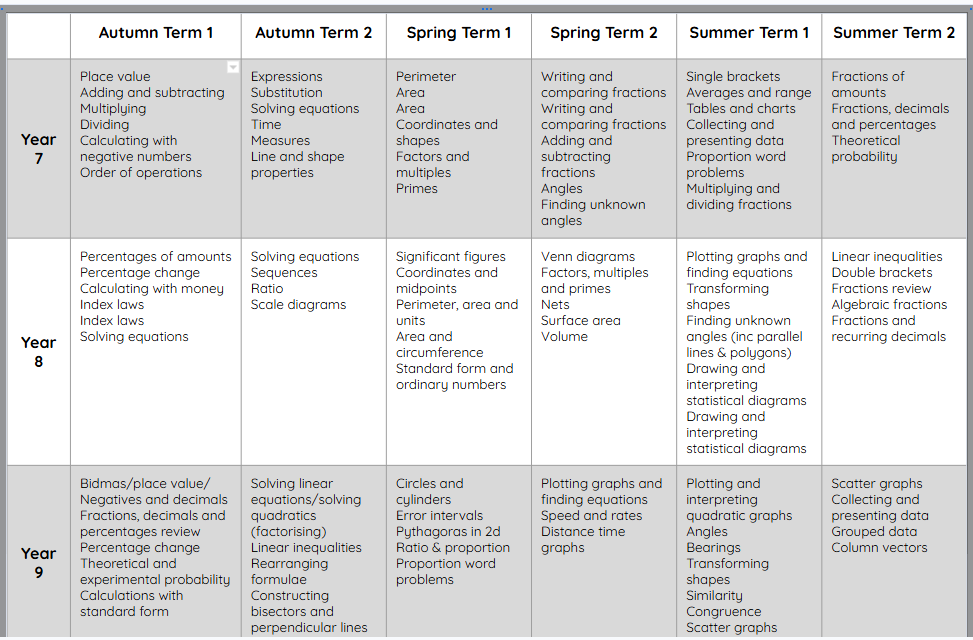
Key Stage 4
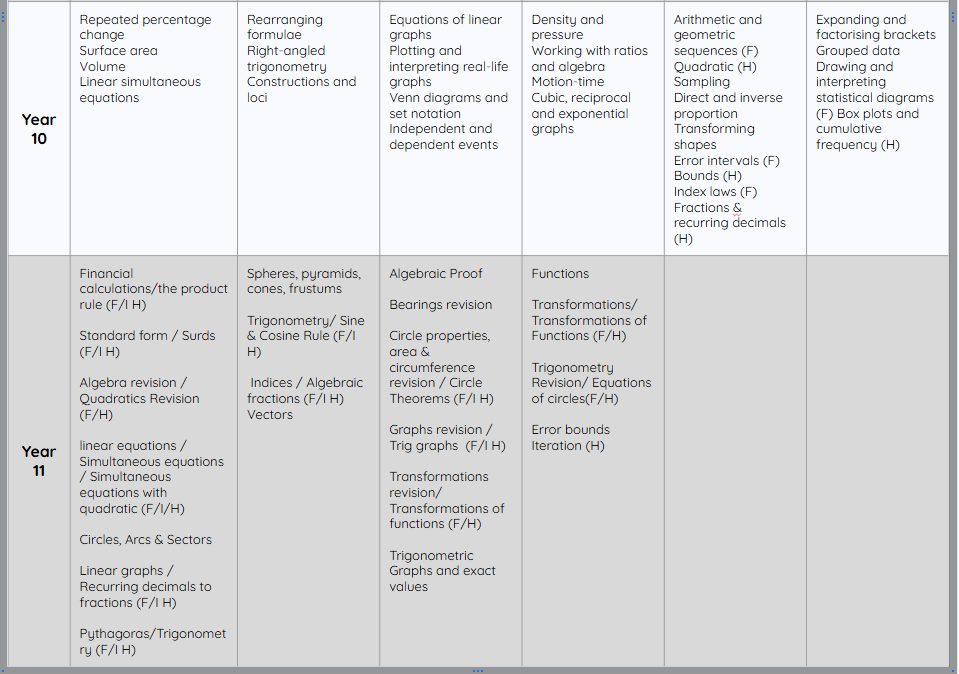
Exam board: Edexcel
Link to exam board: https://qualifications.pearson.com/en/qualifications/edexcel-gcses/mathematics-2015.html
Modern Foreign Languages
Head of Subject: Mr Murray
Contact: cmurray@chessington.kingston.sch.uk
Overview
At Chessington School, the Spanish curriculum is designed to inspire all students to see themselves as successful language learners and to want to continue studying languages at GCSE and beyond. We believe that learning a language helps students become confident communicators, broadens their understanding of the world and opens doors to new cultures and opportunities.
The Languages Department vision is centred around three key principles:
-
Fostering a culture of joy in language lessons - We create engaging and enjoyable lessons where students experience success and develop a positive attitude towards language learning.
-
Developing students who feel comfortable and safe to have a go - We encourage students to take risks, learn from mistakes and build confidence in speaking and using the language.
-
Encouraging inquisitivity about language learning - We help students become curious about how languages work, make links between languages and develop an interest in other cultures and ways of life.
Key Stage 3
|
Autumn Term 1 |
Autumn Term 2 |
Spring Term 1 |
Spring Term 2 |
Summer Term 1 |
Summer Term 2 |
|
|
Year 7 |
Introducing yourself |
Spare time activities |
School life |
|||
|
Year 8 |
My family and friends |
My city |
Holidays |
Everything about me |
Food and eating |
Revision |
|
Year 9 |
Jobs and the future |
Staying healthy |
Young people in action |
Traditions |
Revision |
|
Key Stage 4
Exam board: Pearson Edexcel
Link to exam board: Pearson Edexcel Spanish (2024)
|
Autumn Term 1 |
Autumn Term 2 |
Spring Term 1 |
Spring Term 2 |
Summer Term 1 |
Summer Term 2 |
|
|
Year 10 |
Having fun |
Travel and tourism |
My people, my world |
Healthy living |
School |
Revision |
|
Year 11 |
My neighbourhood |
A better world for everyone |
Your future |
Revision |
||
Music
Head of Subject: Mr. Dubock
Contact: jdubock@chessington.kingston.sch.uk
Overview
The aim of Music at Chessington is to inspire pupils to want to make music from a range of styles and be able to perform confidently in a range of solo and ensemble contexts fluently and with accuracy and expression. It will give students the belief to improvise and compose independently, using relevant notations. The curriculum aims to develop a deepening understanding of the music that the students perform and to which they listen; and its history.
Studies have shown that studying music prolongs life and releases positive endorphins. Music is studied to understand its profound impact on human cognition, history, and emotion, while it is important because it enhances brain development, fosters social connection, and provides a universal language for self-expression. It improves academic performance (math/literacy), boosts confidence, and offers a creative outlet that reduces stress.
Within the curriculum, students will be looking at a range of 20th Century styles from around the world intended to engage learners and learn about music theory, terminology and music history. The approach focuses on listening, composing and performing skills development. There is more emphasis on practical lessons in order to engage students, linking theoretical knowledge and developing their independence and resilience.
Key Stage 3
|
Autumn Term 1 |
Autumn Term 2 |
Spring Term 1 |
Spring Term 2 |
Summer Term 1 |
Summer Term 2 |
|
|
Year 7 |
Keyboard skills |
Ostinato & ensembles |
Samba |
Ukulele |
Major/Minor/ Pentatonic |
Music for events |
|
Year 8 |
Keyboard skills |
Rock n Roll |
Songwriting |
Ukulele |
Scales, chromatic & Film themes |
Film soundtrack |
|
Year 9 |
Improvisation/ Aural Tradition |
Music Technology |
Ensemble skills |
Ukulele |
Western Classical music |
Remix/covers |
Key Stage 4
Exam board: Edexcel Pearson
Component 1 Exploring Music Products and Styles
Component 2: Music Skills Development
Component 3: Responding to a Commercial Music Brief
Link to exam board: here
|
Autumn Term 1 |
Autumn Term 2 |
Spring Term 1 |
Spring Term 2 |
Summer Term 1 |
Summer Term 2 |
|
|
Year 10 |
Component 1 Exploring Music Products and Styles |
Component 2: Music Skills Development |
||||
|
Year 11 |
Component 2: Music Skills Development (cont.) |
Component 2: Music Skills Development |
||||
Personal Development and Wellbeing
Contact: Mrs Rowden
Overview
At Chessington Secondary School, our Personal Development and Wellbeing (PDW) curriculum is designed to empower students to navigate the complexities of the modern world with confidence, resilience, and compassion. We believe that academic success and personal growth go hand-in-hand.
Our curriculum ensures our students are prepared for being healthy, independent, and socially responsible citizens who can make informed decisions about their lives and futures. While our primary focus is the personal growth and individual well being of each student, our curriculum naturally embeds and promotes fundamental British Values which are woven through our daily discussions and topics
By the time a student leaves Chessington Secondary School, our PDW curriculum aims to ensure they will possess the emotional intelligence, critical thinking, and moral compass required to thrive in a diverse and rapidly changing world.
Key Stage 3
|
Autumn Term 1 |
Autumn Term 2 |
Spring Term 1 |
Spring Term 2 |
Summer Term 1 |
Summer Term 2 |
|
|
Year 7 |
Respectful friendships |
Healthy lifestyles |
Skills for the future |
Online safety |
Families |
Health protection and prevention |
|
Year 8 |
Wellbeing |
Reality V the online world |
Drugs and alcohol |
Respectful relationships and friendships |
Financial decisions |
Law and justice |
|
Year 9 |
Being safe in relationships |
Intimate relationships |
Careers |
Democracy in the UK |
First Give charity action project |
Peer influences |
Key Stage 4
Universal Values:
|
Autumn Term 1 |
Autumn Term 2 |
Spring Term 1 |
Spring Term 2 |
Summer Term 1 |
Summer Term 2 |
|
|
Respect for Human Rights and Human Dignity |
Anti-Racism |
Diversity and Inclusion |
Equality vs Equity |
Environmental Stewardship |
Social Justice and Activism |
Physical Education
Head of Subject: Miss E Williams
Contact: ewilliams@chessington.kingston.sch.uk
Overview
At Chessington School, our Physical Education curriculum is designed to inspire every student to develop the confidence, competence, and motivation to engage in physical activity and competitive sport beyond their time at school.
We focus on developing fundamental movement skills across a wide range of activities, while also nurturing key personal qualities such as teamwork, leadership, and resilience. Through a broad and balanced curriculum, students are encouraged to challenge themselves, work effectively with others, and respond positively to both success and setbacks.
We strive to create an environment where students feel supported and empowered to take risks, reflect on their progress, and take ownership of their development. By fostering positive attitudes towards fitness and wellbeing, we aim to equip all students with the knowledge and skills needed to lead healthy and active lifestyles.
Key Stage 3
|
Autumn Term 1 |
Autumn Term 2 |
Spring Term 1 |
Spring Term 2 |
Summer Term 1 |
Summer Term 2 |
|
|
Year 7 |
-Rock Climbing -Gymnastics -Fitness |
-Rock Climbing -Gymnastics -Fitness |
-Football -Basketball -Netball |
-Football -Basketball -Netball |
-Athletics -Team Building/ OAA |
-Athletics -Team Building/ OAA |
|
Year 8 |
-Tag rugby -Basketball |
-Tag rugby -Basketball |
-Handball -Tchoukball -Fitness -Table Tennis |
-Handball -Tchoukball -Fitness -Table Tennis |
-Athletics -Striking and Fielding |
-Athletics -Striking and Fielding |
|
Year 9 |
-Volleyball -Badminton -Dance -Netball -Football |
-Volleyball -Badminton -Dance -Netball -Football |
-Volleyball -Badminton -Dance -Netball -Football |
-Athletics -Striking and Fielding -Ultimate Frisbee -Dance/ Fitness |
-Athletics -Striking and Fielding -Ultimate Frisbee -Dance/ Fitness |
-Athletics -Striking and Fielding -Ultimate Frisbee -Dance/ Fitness |
Key Stage 4 - GCSE PE
Exam board: AQA GCSE PE
Link to exam board: here
|
Autumn Term 1 |
Autumn Term 2 |
Spring Term 1 |
Spring Term 2 |
Summer Term 1 |
Summer Term 2 |
|
|
Year 10 |
Chapter 3 - Physical Training |
Chapter 1 - Applied Anatomy and Physiology |
Chapter 5 - Sport Psychology |
Chapter 7 - Health, Fitness and Wellbeing |
NEA Written Coursework |
NEA Written Coursework |
|
Year 11 |
Chapter 1 Continued - Applied Anatomy and Physiology continued Submission of NEA Written Coursework |
Chapter 2 - Movement Analysis |
Chapter 6 - Cultural Influences NEA practical Moderation |
Revision/ Exam Preparation |
Exam |
Key Stage 4 - Level 2 Sport BTEC
Exam board: Pearson
Link to exam board: here
|
Autumn Term 1 |
Autumn Term 2 |
Spring Term 1 |
Spring Term 2 |
Summer Term 1 |
Summer Term 2 |
|
|
Year 10 |
Components of a Warm Up & Cool Down Planning a Warm Up Body Systems Response to Warm Up |
Delivering Warm Up to Peers Applying Sports to an Individual’s Needs Barriers to Participation |
Clothing, Equipment & Technology in Sport |
Completing Component 1 Coursework |
Coaching for Main Sport Practical Sport Skills |
Delivering Coaching Sessions to peers Officiating in Sport |
|
Year 11 |
Completing Component 2 Coursework Coaching Plans Coaching Sessions and Skills Components of Fitness Competitive Skills Assessment |
Fitness Testing Training Methods |
Principles of Training (FITT/SPORTVAIR) Target Setting (SMARTER) |
Fitness Training Programmes Motivation Component 3 Exam Prep |
Exam |
Religious Studies
Head of faculty : Mr Forsyth
Contact: bforsyth@chessington.kingston.sch.uk
Overview
Our Religious Studies curriculum is designed to provide an objective, academically rigorous, and deeply enriching exploration of the world’s major religions, non-religious world-views, and ethical frameworks. We intend to equip students with the critical thinking skills, literacy, and cultural capital necessary to navigate a diverse and rapidly changing global landscape. Rather than promoting a specific faith, our curriculum fosters a deep, empathetic understanding of how and why people believe, behave, and find meaning in the world.
Key Stage 3
|
Autumn Term 1 |
Autumn Term 2 |
Spring Term 1 |
Spring Term 2 |
Summer Term 1 |
Summer Term 2 |
|
|
Year 7 |
What is RS and why is it important? |
Is the concept of God coherent? |
What do we mean by Abrahamic faiths? |
What are the key features of Judaism? |
What are the key features of Islam? |
What are they key features of Christianity? |
|
Year 8 |
Hindu beliefs |
Hindu practices |
Buddhism beliefs |
Buddhism practices |
Sikhism beliefs |
Sikhism practices |
|
Year 9 |
Is there a God? |
Is Britain still religious? |
What do religions say about human rights? |
What do religions say about social justice? |
Cults/new religious movements? |
Medical ethics |
Key Stage 4
Exam board: AQA
Pathway/option: Religions: Islam and Christianity, Themes: crime and punishment, human rights and religion and life
Link to exam board: here
|
Autumn Term 1 |
Autumn Term 2 |
Spring Term 1 |
Spring Term 2 |
Summer Term 1 |
Summer Term 2 |
|
|
Year 10 |
Christian beliefs |
Christian Practices |
Islam beliefs |
Islam practices |
Themes- Religion and life |
Themes- Human rights and social justice |
|
Year 11 |
Themes- Crime and punishment |
Themes- Human rights |
Themes - Human rights |
Revision |
Revision |
Revision |
Science
Head of Subject: Mrs L Andrew
Contact: ladade@chessington.kingston.sch.uk
Overview
At Chessington School, our science curriculum is built on the core belief that every child, every day should have the opportunity to succeed. We deliver an ambitious, knowledge-rich, and carefully sequenced education across Biology, Chemistry, and Physics to build long-term retention and a deep understanding of the world. Ultimately, our curriculum empowers all students to analyse the world around them, achieve outstanding academic outcomes, and build the critical knowledge and cultural capital required to thrive in their future careers as responsible individuals.
Science is the study of the universe through observation, questioning, and experimentation. In our curriculum, studying science is not just about memorising facts; it is about developing a powerful framework for thinking. Students learn to analyse evidence, solve complex problems, and understand the interconnected systems of our world. This journey fosters a deep sense of curiosity and equips learners with the scientific literacy needed to make informed decisions about global challenges, driving innovation and shaping the future.
Science is vital because it is the tool we use to understand how the world works and the wider universe. It empowers students to move beyond simply accepting facts, teaching them instead to ask "how" and "why" through evidence-based inquiry. A strong foundation in science develops essential life skills: critical thinking, objective analysis, and creative problem-solving. Ultimately, science is important because it equips the next generation to navigate an increasingly technological world and make informed choices about health and the environment.
Key Stage 3
|
Year 7 |
Year 8 |
Year 9 |
|
|
Autumn 1 |
Working Scientifically, Maths in Science, Energy |
Working Scientifically, Maths in Science, Genes |
Atomic structure, Energy |
|
Autumn 2 |
Ecosystems, Matter |
Matter, Energy |
Energy, Cell Biology |
|
Spring 1 |
Forces, Organisms |
Energy, Reactions |
Cell Biology, Structure and Bonding |
|
Spring 2 |
Organisms, Earth |
Organisms |
Matter, Organisation |
|
Summer 1 |
Genes, Electromagnets |
Reactions, Forces, Waves |
Organisation, Chemical changes, Infection and Response |
|
Summer 2 |
Electromagnets, Revision for End of Year exams |
Revision for End of Year exams |
Infection and Response, Waves |
Key Stage 4
Exam board: AQA
Links to exam board for:
Combined Science
Separate Sciences
Biology
|
Autumn Term 1 |
Autumn Term 2 |
Spring Term 1 |
Spring Term 2 |
Summer Term 1 |
Summer Term 2 |
|
|
Year 10 |
Bioenergetics, Homeostasis and Response |
Homeostasis and Response |
Variation, Inheritance and Evolution |
Variation, Inheritance and Evolution Revision for mock examinations |
Variation, Inheritance and Evolution |
Ecology |
|
Year 11 |
Ecology |
Ecology |
Revision for final GCSE examinations |
Revision for final GCSE examinations |
Chemistry
|
Autumn Term 1 |
Autumn Term 2 |
Spring Term 1 |
Spring Term 2 |
Summer Term 1 |
Summer Term 2 |
|
|
Year 10 |
Chemical changes |
Chemical changes |
Energy changes Quantitative Chemistry |
Quantitative Chemistry Revision for mock examinations |
Rate and extent of Chemical Change |
Rate and extent of Chemical Change Organic Chemistry |
|
Year 11 |
Organic Chemistry |
Organic Chemistry Chemical analysis |
Chemistry of the atmosphere Using resources |
Using resources Revision for final GCSE examinations |
Physics
|
Autumn Term 1 |
Autumn Term 2 |
Spring Term 1 |
Spring Term 2 |
Summer Term 1 |
Summer Term 2 |
|
|
Year 10 |
Atomic structure P2 Electric circuits |
Electric circuits |
Forces |
Forces Revision for Mock examinations |
Forces |
Waves |
|
Year 11 |
Waves |
Waves |
Magnets and Electromagnets Revision for final GCSE examinations |
Revision for final GCSE examinations |